Saturday, June 27, 2009

The Jungle Medic

The following is a reprint from our article in Sounding Magazine. Enjoy.

Cruising does not always mean boisterous passages or cocktails on the aft deck at sunset. To the contrary, much of our time is spent exploring the country side and getting to know the local people. This approach for my wife Susan and I has enriched the experience far beyond what we expected when we moved aboard Sea Trek, our Mariner 40, and started the cruising life almost 18 years ago. Beginning in mid April of 2005 the passage from the
Florida Keys, down the coast of Mexico, and wandering through the many Cays in Belize had been wonderful. But that did not compare to our fantastic experience upon arriving on the Rio Dulce in Guatemala.

We had heard from many sources, of the wonderful work done here by Bryan Buchanan and his wife Riechelle. Bryan is a certified paramedic and has done a residency here with a family practitioner and he has also done some dental training. Both he and Riechelle have been Missionaries in third world countries for several years, the last few here in Guatemala. They primarily travel to remote villages that do not have access to medical care and set up their clinic for the day, but they will offer care and medication to anyone that might need it, including the local cruising community. Bryan and Riechelle are known locally on the river as The Jungle Medic.

Each morning on the river at 07:30 there is a cruisers net on VHF channel 69. So when the call went out for volunteers for one of Bryan’s clinics we jumped at the chance, and so did several others. Crew from Nueva Vida, Dragonet, Island Time, Anon, T.O. Sea, Morenga, Balance, Rose of Sharon, Bold Venture, Pegasus and of course our own Sea Trek answered the call. Arrangements were made by Bryan to pick up the individuals at the various Marinas in his van on Wednesday and we all met at Bryan's home just outside of town. The turnout was great and we had 25 volunteers for our "team". Bryan instructed us as to what to expect and how to set up for the clinic. We were all also issued scrubs for the purpose of showing the villagers that we were part of the team and there to help them as opposed to just a group of Gringos. Bryan also noted that this was a very large village by comparison to others he regularly visits and it was also a very sick village. Because he had needed to assemble a large enough group, but until now had been unable, the village had not been visited for almost a year. He generally tries to return every few months to the areas he has covered.

The next morning at 08:00 we set out in two vehicles. Bryan's van with a trailer in tow, carrying all the medical supplies, and a Jeep loaned to us by one of the local Marinas. The village was approximately 45 miles away. Once we had left the main paved road the going was considerably slower. After about an hour we reached the village and began to set up tables and the supplies on the front "porch" of two buildings of the school. Immediately after our arrival the villagers began to line up for what proved to be a long day. It had rained that morning and all of the grounds were muddy and it continued to rain off and on several times that day. We all received thorough instructions on just what our assignments were and exactly how to perform them. Once everything was ready and we were sure of what to do the first villagers started down the line.

This is not a true Medical Clinic in the sense that most might normally consider. There are no Doctors here most of the time. We had one other certified paramedic and two experienced nurses as part of the group. No one tries to diagnose serious illnesses or treat those that should see a doctor or be treated in a hospital. Those people are told they must go to one of the larger cities for appropriate treatment and Bryan frequently assists them by providing transportation. Our purpose there was to treat the most common problems related to the lifestyles and environment in which these people live. The most significant issues are infections that needed antibiotics, treatment of various types of worms that affected most of the children, and getting everyone some type of nutritional supplement since the local diets are very poor and lacking even the basics. This is indeed simply putting a band aid on a wound but as we saw it does make a difference in their lives and they do respond to it.

This was a local village of the Kek'chi Mayan Indians. That does present somewhat of a language barrier since none speak any English and most do not even speak Spanish. And add to this the fact that there are over 20 different dialects. The few that spoke Spanish served as interpreters including the village Chief who helped in translating and keeping order as the day progressed. We could usually get the message across using some crude sign language. This village was very near a local tourist attraction so they were somewhat used to interacting with outsiders.


Each family was seen as group and at least one parent had to accompany any children. One thing that struck us right off was the lack of men waiting in line. We later found out that they usually won't come because it is not macho to stand in line with the women and children or to admit that you are sick. Many are also out working during the day. The line was very long and there were many children including some very young girls, only teens themselves, with three, four, and five children. These were the ones we were especially there to help. Riechelle kept control of the line and assigned numbers to each individual, but as a family group. The number was written on the back their hands so we could keep track.

Their first stop was at the table of either Bryan or the other paramedic, Mark. They determined the specific needs and wrote that down on a piece of paper with the number that coordinated to the one on their hand. They then moved to the next table, or station, and we would check their paper to see if they needed anything from our station. The paper needed to match the number on their hand since many mothers carried the papers for all their children. Most of the children required worm medicine which was liquid given orally. Next the children and adults were given vitamin supplements. They had been given instructions at the paramedic’s station by the interpreter as to when and how to take the pills or capsules. Next stop was for skin problems as well as eyes, and ears. Any needed antibiotics were applied by the team members. Their last stop was the pharmacy station. Each of the two pharmacy stations were manned by one of the two nurses on the team along with one helper that could at least speak Spanish. Since Susan speaks pretty good Spanish she was assigned to one of the pharmacy stations. Most of the items passed out there were some form of oral antibiotics to treat the infections diagnosed by the paramedics. There was a station set up in the middle of the school grounds at the town water pump. This station was to wash and treat the hair of the children infected with lice. We saw women and children from infants to ages I did not even want to guess.


We had started early in the morning and except for a quick lunch break finished up by mid afternoon. We saw, in all, almost 500 people. Several of us had brought along our digital cameras to photograph our experiences. The children were delighted to have us take their picture and then show them the results on the cameras LCD screen. Except for reflections in the water most had never seen an image of themselves. It was indeed a moving experience and we will jump at the chance to go again. At the end of the day we all had a good feeling inside and knew that we had made a difference in these peoples lives however small it might be. It also showed them that there were people out there that cared about their welfare. This was an experience that we will never forget. And the small space here really can not give it proper understanding.

At the end of the day we were all pretty tired but Bryan's offer to take us to the local tourist attraction, which happened to be a nearby waterfall, was too good to resist. We packed up everything in the vans and headed out. The waterfall is just across the river and a little up stream from the village. It originates from a hot spring on a cliff above that has a constant temperature of about 120 degrees. Pools at the top are better than any hot tub. The water fall tumbles into the very cool river below and the temperature difference leaves a mist on the water. You can swim from the very cool water in the river to the heated water as it runs down the waterfall. It is a great experience and we know why the tourists like to come here. This was the perfect end to an unforgettable day. As we were leaving the falls it rained again and we had a very cool drive back to our Marinas. We went to bed that night exhausted but satisfied that we had been able to give something back to these people that allowed us to share some of their beautiful country.


Bryan's clinics are not always conducted by layman. He has a group of Doctors from outside the country that participates on a regular basis and it is not unusual for him to have medical teams booked for a year in advance. He spends some time each year in the US speaking at various venues and is constantly finding medical folks willing to donate their time to this great cause. His funding comes from many private donations from folks that know of the good work he and Riechelle do, as well as a few churches that regularly donate to the cause. But funds are always needed and appreciated. Also many individuals as well as drug companies in the US regularly send donated medicines and vitamins. At the writing of this article Bryan is in the field with a full medical team for ten days.

Bryan and Riechelle also have a completely converted and fitted medical bus outfitted in the US and brought to Guatemala by the US Air Force. It has complete diagnostic, treatment and lab equipment as well as examining rooms. The bus will greatly improve the quality of care that Bryan and his teams will be able to provide these wonderful people. The United States Air Force graciously agreed to fly the bus down on a military transport. You can find out more about the work that Bryan and Riechelle do and see some wonderful photos from some of the villages they have visited. The website is http://www.junglemedicmissions.org and should not be missed. If anyone ever has the opportunity to come and visit here and participate in Bryan's clinic we highly recommend you do so. It might just be the experience of a lifetime. And you can sure bank a bunch of good karma. Chuck and Susan

Tuesday, June 16, 2009

A Trawler Makeover

With all of the reality TV shows bordering on the ridiculous this might not be a bad idea. We certainly are delighted with the progress on Beach House and the compliments pour in from everyone that sees her. Especially those that have seen her prior to our taking ownership. The transformation has been amazing and when we walk down the dock we sometimes have to stop and admire our handy work. We are still a long way from being cruising ready since most of our efforts have been on the exterior and redoing and improving the teak, paint and canvas. Electrical and electronics have been slow going and we have only completed what needs to be done to keep her safe and keep the on board equipment working. With the heat of the summer bearing down on us hard, it might be time to work on interior projects in the air conditioning.

As of now Beach House is official with her name on the stern and documentation number permanently affixed. We have been putting this off because the hull, although in decent condition, will be in need of a new paint job in the next couple of years. We didn't want to spend the time and money to paint or have vinyl made up for the stern and then take it all off for painting, so before the name went on, the stern needed to be done. In between two weeks of rain off and on, we were able to get three coats of AwlGrip 545 primer on and three coats of AwlGrip Cloud White. As is our usual practice we were able to roll the paint on without tipping and it looks as if it has been sprayed. We know that because the owner of the local yard came by and ask how we sprayed it in the water. We had the vinyl lettering made up by Speedysigns, http://www.speedysigns.com/ , and they did a fantastic job, shipped them to us quickly and were exactly as we ordered. They have a great web page, http://www.speedysigns.com/lettering/lettering_tool.asp , that allows you to try out the different fonts and colors. They do graphics and all kinds of lettering and banners, so they can handle almost any request. The installation was easy. The surface needs to be clean and the graphics taped in place and marked with a pencil. There is an applicator kit available and we recommend it. Once you are satisfied with the placement, the graphics are folded back half way and the backing paper is removed leaving them on a clear vinyl covering. The applicator fluid is sprayed on the area and the graphics are lined up with the pencil marks you have made. The entire surface is squeegeed to remove all air bubbles and then the clear vinyl covering is removed leaving only the graphics. A final squeegee is all that is needed and you are done. With one half done, the process is repeated for the other half. The results look fantastic and we have found in the past the vinyl is more durable and longer lasting than paint. And the cost is about 1/10th of what it would have cost us to have someone come to the boat and paint the name on.

We are also replacing all of the old canvas. Much of it is aged and worn and showing signs of severe wear and tear. So far we have made window covers for the lower helm station, screens for the port and starboard opening windows, a cover for the forward hatch that we just refinished, and the biggest project of all, a new bimini top. This was a week long project in itself and this is only the second bimini we have ever made. It was quite a while ago since the last one so it was a learning experience all over again. Several years ago we spent the money and bought a good Sailrite sewing machine. They are expensive but this was some of the best money we have ever spent. Being able to do our own canvas work has saved us thousands of dollars over the cost of the machine. To make the window and hatch covers, as well as the screens, we made patterns out of heavy brown paper and transferred them on to the fabric. But with the bimini, we measured the width we wanted it to be, calculated the length based on the stainless frame and add about ten inches to each end. Using 54 inch material we sewed the center for the two panels and then sewed the hems down both sides. Once this was completed we set up the frame using packing tape to hold it in the position it would be with the bimini up. Then the new material was laid over the frame and clamped in place with upholstery clamps. The ends were marked to follow the shapes and curves of the frame and allowing the extra material to overhang the ends. this would be used for the end pockets with zippers. The position of each bow of the frame was marked with chalk on the underside. Then the material was removed, placed flat on the floor and the ends cut as marked. The end pockets for the zippers and the pockets for all of the bows of the frame were cut, hemmed, and the zippers added. We also put some additional stainless supports on the frame to eliminate the need for straps to hold the ends tight. After it was finished and placed on the frame it looks great. By doing this ourselves we probably saved about $2,000.00 or more if we did not count our own labor. We are by no means professional canvas makers, but our results have been pretty good and we are very satisfied. Progress is being made and we have more canvas work to do. Painting of the fly bridge and finishing the flybridge teak is now at the top of the list. We have purchased two bench seat that are designed for pontoon boats and mounted them on the flybridge. They look good and give us more storage space, which was our biggest consideration for this purchase. We purchased them from http://www.pontoonstuff.com/ and are very pleased with the product and their fast shipping. They arrived in about three days and took all of 15 minutes to assemble. All of our projects should go that easily! So that is how the makeover has gone so far. We will keep posting as things progress and we hope you enjoy the information and find some of it useful.

Wednesday, June 10, 2009

For Many of Our Cruising Reports

Please do drop by our site for our sailboat Sea Trek at http://sea-trek.blogspot.com/ to read our detailed reports on our cruises to Cuba, Central America as well as our coastal trip from Houston, Texas to Beaufort, South Carolina. You will also find lots of information on our cruising equipment and preparations. Enjoy.

Friday, June 5, 2009

Refinishing The Hatches

We have not slowed down on the projects we just haven't posted because we have been so busy. The teak on the exterior is just about finished, leaving the flybridge yet to be done. For the last couple of weeks we have been repairing and refinishing the forward hatch and the hatch and entrance to the aft cabin. Both of these have leaked quite a bit requiring us to keep a sheet of plastic over the hatch under the canvas covers. Once we had them off it was quite apparent why. The forward hatch had two pieces of glass in it that was set in a grove with the edges exposed and held in with caulk. The caulk was old and in spots broke down and the water was able to get in around the edges. Once the wood was thoroughly sanded and the old caulk removed, we recaulked with 3M 4200 and put a nice teak trim over the edge of the glass and overlapped the wood. With the caulking underneath sealing everything it is now water tight. A good thunderstorm this afternoon affirmed that we had indeed solved that problem. A few seams that had opened up were also sealed with West System Epoxy. As with all of the exterior wood we had to sand off all of the deck stain the previous owner had applied. We did find a product at the local hardware store that was for removing deck stain and it did make the job much easier. Both the inside and outside of the hatch needed to be stripped and sanded.

Our preference for the exterior as usual has been Sikkens Cetol. All areas had three coats of the "Natural" which is the newer color that leaves the wood looking like teak without the brown or yellow hue like others we have tried. It takes 24 hours between coats but we like the Sikkens because as long as the next coat goes on within 24 hours there is no need to sand between coats. Once the 3 coats are completed and dry we apply 3 coats of the "Clear Gloss" to give it that varnished shine and to further protect the wood. We have used just the base coat but found it not as UV resistant as adding the gloss. Once again, 24 hours between coats with no need to sand. The results are a high gloss beautiful finish that everyone give us great compliments on.

The interior is not as exposed to the elements so for that we use the same high gloss coating we use on other areas of the interior. For this, we chose to use a product called "Ultimate Sole" which is designed to refinish the floors but is excellent for any areas that a tough high gloss is desired. This generally also takes 3 coats and does require sanding between coats. It flows on with the consistency of water and is applied with a foam brush. The results are stunning and the finish is very durable. On the cabin sole this finish is no where near as slippery as more traditional finishes. We even use it inside the shower on the teak grates and trim.

The aft hatch was quite a bit more work. The hatch originally was a plywood core with teak slats overlaid and teak around the sides. Over the years the slats on top had leaked and damaged the plywood core. Someone at some point removed some of the plywood and stuffed foam in its place. Some of the teak slats had been damaged and repaired with Bondo. The whole mess was covered with deck stain. The first task was to take as much apart as possible without having to do a total rebuild, remove the foam and replace the missing plywood. While doing this everything was sealed completely with West System Epoxy. Once the core was repaired we acquired some old pieces of teak decking that was a perfect fit to replace the damaged pieces on the top. These too were epoxied into place in addition to screwing them down and putting bungs in the screw holes. Once the repairs were completed the entire hatch was sanded and any problem seams sealed with West System. The teak slats were caulked with Sikaflex, which is my preference for caulking decks. With the repairs completed the Sikkens was applied the same as the forward hatch.

Once all of the finishes had completely dried, all of the hardware was reattached and the hatches and doors reinstalled. Theses are the last two major areas on the lower decks and with their completion the boat is really looking good. Everyone that passes comments on how great the teak looks. We will soon begin the teak on the flybridge and have decided that we will also paint the entire bridge at the same time. We have also completed the paint on the stern and will begin putting that all back together and finally get the name on the boat. We are also working on replacing the old canvas covers including a new bimini. But that is for another post.

Product Safety Recall: Garmin® BlueChart g2 and g2 Vision v2009

Product Safety Recall: Garmin® BlueChart g2 and g2 Vision v2009

Posted June 4, 2009 | 09:17 AM in Marine | Permalink

CAYMAN ISLANDS/June 4, 2009/Business Wire – Garmin Ltd. (NASDAQ: GRMN), the global leader in satellite navigation, announced today that the company is conducting a voluntary product safety recall of the 2009 version of its marine cartography data card known as BlueChart® g2 and g2 Vision. The affected data cards have been sold between April 8, 2009 and June 3, 2009.

In certain waters, the data card provides inaccurate indications of the depth of the water. This creates a risk of boats going aground, which could result in damage to the boat and/or personal injury.

While Garmin has only received reports of data cards giving inaccurate depth indications in the waters along the coast of Sweden and Denmark, out of an abundance of caution, Garmin has voluntarily chosen to globally recall all 2009 versions of the BlueChart g2 and g2 Vision cards. Garmin has notified relevant authorities about this issue and is working closely with them. No other products are affected by this recall.

Affected products are the 2009 version of the BlueChart g2 in Garmin proprietary card format, BlueChart g2 in microSD/SD card format and BlueChart g2 Vision in microSD/SD card format. Customers are being advised not to use these data cards for navigation.

Affected customers will be provided with a free replacement BlueChart or BlueChart g2 Vision v2008.5. When the 2009 version has been corrected Garmin intends to make it available free of charge to those customers. For more information on the recall and to determine if their cards are affected and eligible for a free replacement, go to www.garmin.com/bluechartrecall.

Thursday, June 4, 2009

Check Your EPIRB Registration

We posted earlier about what happens when you activate your EPIRB. Now comes a notice that perhaps there is a problem with the EPIRB registration at NOAA.

FORT LAUDERDALE, FL - APRIL 23, 2009 - Cobham Life Support, ACR Products, the world's leader in safety and survival technologies, is urging all EPIRB and PLB owners to double check their 15-character identification code registration.

According to a recent Marine Board of Investigation inquiry, which is looking into the sinking of the scallop boat Lady Mary on March 24th, there was a discrepancy in the EPIRB's identification number, marked on a decal that the boat's owner had received from the National Oceanic and Atmospheric Administration after he registered the EPIRB.

In the case of the Lady Mary, the emergency signal initially received by authorities was regarded as unregistered which may have led to delays in response time while emergency center controllers waited for additional satellite passes to fix a location. Had the controllers been able to pull the Lady Mary's registration data, they could have contacted emergency contacts to confirm the status of the boat and its general location prior to a satellite fix.

"Because this situation came to light, we are urging all beacon owners to compare their 15-character identification code printed on the beacon with the registration sticker they receive from NOAA just to ensure they both match," said Chris Wahler, Marketing Manager for Cobham Life Support, ACR Products. "If there is a discrepancy, we urge the owner to contact NOAA immediately to correct the information."

An EPIRB (Emergency Position Indicating Radio Beacon) or PLB (Personal Locator Beacon) is a satellite-signaling device of last resort, for use when all other means of self-rescue have been exhausted and where the situation is deemed to be grave and imminent, and the loss of life, limb, eyesight or valuable property will occur without assistance. All US beacons must be registered with NOAA following purchase. Registration, including the beacon's unique 15-character identification code, often is made online at www.beaconregistration.noaa.gov.

Despite the requirement to register all EPIRBs and PLBs, some reports show that up to 40 percent of EPIRB activations are from unregistered beacons, a possible deadly mistake when minutes can make the difference between life and death.

In an emergency, the EPIRBs and PLBs transmit on 406 MHz via the Cospas-Sarsat satellite system with the sender's unique, registered, digitally coded distress signal. The code allows emergency officials monitoring the system to tell who is sending the signal (thanks to the coding and registration data). Once the emergency is confirmed and location data is received from the satellites, a search can be authorized.

Wahler said proper registration is vital in the early minutes of an emergency so rescue center officials can obtain critical data about a boat's owner, home port, emergency contacts and other information to begin a search even before a satellite gets a fix on a beacon's location.

See our previous post on http://trawler-beach-house.blogspot.com/search/label/You%20activated%20your%20EPIRB...%20now%20what%3F

Saturday, May 23, 2009

Cruising In a Down Economy

This is from our recent article in Soundings Magazine

My wife Susan and I made the decision almost twenty years ago to buy a boat and go cruising while we were still young and healthy enough to enjoy the lifestyle. Watching friends plan and work for years, then have their dreams smashed on the rocks due to health or family issues was a driving factor in this decision. The one major stumbling block in our plan was the financial aspects. We are neither wealthy, retired with a pension, or on the list of a family member to inherit a lot of cash. So how in the world would we accomplish this with no income once the dock lines were untied and we left our home waters? Those are tough and scary decisions but they needed to be overcome if our plan would work. The solution would be to buy the boat with the sale of our property and business, outfit it for extended cruising, put enough money in the bank to carry us through our cruise, and then get us to a place where we could settle in and find jobs to build the cruising kitty so we could start again. For the plan to work, we also needed to keep our expenses to a minimum without making our cruising lifestyle a bit more than a survival existence. It was important to us that we enjoy the ride and have a great time or it did not make sense to do this at all. After 17 years aboard our Mariner 40 ketch, Sea Trek, and with tens of thousands of miles under the keel, we are now switching gears and have recently purchased a Marine Trader 34 trawler so that we might enjoy some new cruising grounds that are just not practical on a deep draft sailboat.

But even that decision had to be part of the overall plan. The “new to us” trawler has a single diesel engine that is very economical and burns only about 1.2 gallons of fuel per hour. Fuel is a major expense for us while cruising, even on a sail boat, since quite often the wind is coming from the wrong direction or there is no wind at all. We are currently doing a complete refit and renovation to make the new boat both comfortable and self sufficient for cruising. Even the choice of equipment and method of installation helps in saving us money, even though the initial outlay may not make it seem so. Installing a $3,000.00 watermaker might seem like an extravagance, but if it keeps us at anchor rather than having to pay for dockage, and not having to pay for water to fill our tanks, then it does not take long to pay for itself. Once that threshold is reached, the unit begins to save money every time it is used. Likewise the expense of building a good charging system using wind generators and solar panels to keep up with our power demands, keep us out of the expensive marinas and limits the number of hours we would need to run the engine and burn expensive fuel.

One of the best kept secrets in the cruising community is the number of free docks along the waterways on the east coast of the US. Once you have made some solid friendships along the way, these secrets will be revealed to you, but they are not publicized for obvious reasons. We thoroughly enjoy being at anchor for the peace and privacy as well as the savings. Finding a free dinghy dock in US waters is getting harder as waterfront access becomes more expensive and areas are developed. But we always seem to find them, be it at a friendly restaurant that will let us tie up if we buy lunch, dinner or have a drink or two, or a shopping center that has a dinghy dock for boaters to come in and shop. We do enjoy the occasional dinner or lunch ashore and find that the eateries frequented by the locals usually have the best food, lowest prices and special offers while the big expensive places are targeted more toward tourists and expensive meals.

When we are outside of the US we love to explore the country, meet the local population and experience the culture. This can be accomplished for much less than one might expect. Quite often we have gathered a group of cruisers and all chipped in to hire a van and driver for a day or two and dividing the cost over two, three or even four couples makes this very affordable. Since the van is ours for the time hired, we can get to the larger supermarkets, wholesale houses, or shopping malls for re-provisioning or finding needed parts. While out shopping we can include stops along the way to visit local museums and historic sites. All give us a good dose of history and flavor and most are also free. We often see parts of the countryside most boaters will never see sitting in the harbor and hanging out at the marinas. There are also many occasions when we take the local transit to get from place to place. Many find this disconcerting, but we find it part of the experience. We have ridden the “chicken bus”, named because many of the riders are carrying their chickens in their laps, across Belize to visit Mayan Ruins and back again and cost us only a couple of dollars. This is probably not for everyone, since the busses can be hot and crowded with no air conditioning, but what a way to meet the natives. Air conditioned busses with movies are available for a bit more money, but still not all that expensive. We try and stay away from the well publicized tourist areas and find places off the beaten path which are sometimes even more interesting. We also cover a lot of miles walking. It is a healthy, enjoyable form of transportation and in many countries what starts out as a good walk, finishes with a pleasant ride with one of the local folks that will pick you up along the way.

This also brings up a subject that many ask when they find out about our lifestyle. How do we cover ourselves for health problems? We have opted to not carry health insurance while cruising since most coverage is not available outside the US, where we travel the most, and if it were, it would be prohibitively expensive and wipe out our entire cruising budget. The cruising lifestyle in and of itself seems to keep us much more healthy than when we are sitting somewhere working toward the next cruise. We have also found that excellent health care at a fraction of the cost in the United States is available almost everywhere we travel. Each person has to make their own decisions with this and consider existing needs and conditions, but we have found this to not be a problem for us in all of these years.

Each decision needs to be made based on how it impacts the cruising kitty. Careful preparation of the boat means less chance of breakdowns and expensive repairs. Being able to affect most repairs by the skipper rather than hiring it out will help in a big way to keep the funds in the bank. Even shopping becomes an adventure to find the local markets where vegetables, fruits, and fresh meats can be bought at a fraction of the cost of the local supermarket. While in the US, we clip coupons from the local Sunday paper to help save $10.00 or more on a weekly basis for groceries. We look for the fuel docks that offer the best prices, even if it means buying fuel before we actually need it. With the new trawler holding 300 gallons of fuel, we can seek out the docks that offer a discount for volume, something we could not do before with the sailboat and a much smaller fuel tank.

A trip to the nearest beach or an excellent snorkeling spot is only a dinghy ride away and other than the cost for fuel for the dinghy is totally free. The dinghy becomes your family car and can get you to the beach or down a beautiful river or stream that probably looks like it did a thousand years ago. Our outboard is kept in top condition to get us there and back and to use as little fuel as possible. Potlucks on shore thrown by cruisers will bring you a banquet for no more than the cost of a single dish you make yourself on board, and bring to share. Local cruiser hangouts can bring impromptu concerts and entertainment that you could never find at Madison Square Gardens. These social interactions and the lifelong friends you make can never have a price put on them. And better yet, every cruiser you meet will have another tip for you to live and enjoy this wonderful lifestyle while maintaining the bank account for a long as possible. Our cruising budget usually averages around $1500.00 per month. We have met cruisers with budgets of $500.00 per month while others could spend $5,000.00 per month.

Don’t let the present state of the economy keep you from pursuing your dreams. Remember the old days when we all lived within our means and tried to have fun in more simple ways. That is the essence of our cruising philosophy.

Tuesday, May 19, 2009

Safe Boating Week, File A Float Plan

safety tip Float Plan

Play it safe, keep a stack of float plan forms on hand. Leave a copy with a friend, relative or local marina before heading out on the water. In case of an emergency, pertinent information will be right at their fingertips to enable them to contact the local marine police or Coast Guard with necessary details. A word of caution—in case you're delayed, and it's not an emergency, inform those with your float plan, and be sure to notify them when you return so the float plan can be "closed out" and an unnecessary and costly search avoided. An example of a float plan is provided here as a PDF.

Sunday, May 17, 2009

Installing An Electric Anchor Windlass

Once again, it is hard for us to believe that after 28 years and an unknown numbers of owners this boat has never had an anchor windlass. We have to think that it did not get much anchoring done over its lifetime but someone somehow managed to bend the shank on the 35 pound CQR that came with the boat. Our cruising style is more anchoring and less marina stays so getting the anchoring system right is very important and with a new storm season less than a month away we felt is was past time to get it done and get it right. An anchor windlass is an important part us our system.

Once the anchoring and bow platforms were refurbished, see http://tinyurl.com/qo8a9r , the next step was to find a windlass that would fit in the space behind the anchor roller and in front of the Sampson post. This is not a large area so a windlass small enough to fit but powerful enough to handle the anchor and rode did not leave us with a lot of choices. Additional weight at the bow is another concern for us. The one we finally decided on that would fit our needs is the Powerwinch. We usually take any manufacturers specs with a grain of salt and any time they are marginal based on their numbers, we go with the next larger size. We sized the windlass, rode, and anchor for a 40 boat. This meant the Class 41 windlass from the Powerwinch line. It fit our space, did not add a lot of additional weight on the bow and seemed to be more than powerful enough for Beach House. The one down side was it does not have the capabilities to manually raise the anchor if power or the windlass quits, but we can live with that since the large anchors and all chain rode we used on our sailboat are a thing of the past.

Using the template provided with the installation instructions which was taped in place to keep it from moving, holes were drilled into the anchor platform for the rode and power cables to pass through, and for the bolts to secure the whole thing. It is important to get these holes aligned properly so once the windlass is mounted, everything lines up accordingly. The windlass also needs to be mounted with the gypsy in a straight line with the fall of the anchor and rode to the bow roller. It does take some pre-planning but in the end it worked out just as we expected it too. The holes drilled into the platform were all sealed with penetrating epoxy to keep as much water intrusion out of the platform as we could considering the amount of moisture this area is exposed to. The placement was also planned to allow the anchor and rode to drop straight down into the deepest portion of the anchor locker as it passed through the windlass. For us this meant moving the anchor hawse pipe since it was originally positioned off to one side. We made a template of the original hawse pipe hole and cut the new one to match as much as possible. The section of the deck that was cut out for the new hole would be used as a plug for the old hole. The sides of the hole were buttered with thickened epoxy and the plug slid into the hole. A layer of fiberglass bi-axial was applied on the top and the bottom of the deck to fully cover the old hole and to keep the deck from cracking around the plug. Once the epoxy had set off, the top and underside were sanded smooth in preparation for coating.

We chose to have a set of foot switches at the bow, and a smaller manual switch at both the lower and upper helm station. The foot switches can be used on the foredeck when raising and lowering the anchor and the helm switches can be used in foul weather or if the person on the bow is otherwise occupied. It also gives us a redundancy should one or the other switch fail. Positioning of the foot switch should be done with consideration for ease of access when raising and lowering the anchor and in keeping it just out of the way so that it will not be constantly stepped on and set off or damaged. Once the location was determined, we drilled a pair of holes in the deck to accommodate the up and down switch. Again, the deck was sealed with epoxy before the switches were installed. We do this any time we drill holes in the deck in order to keep water intrusion out of the core of the deck should a leak ever develop. With the holes drilled, the deck sealed, and comfortable everything was correct, the switches and covers were installed with a heavy dose of bedding compound. For the foredeck area where water will be a common occurrence, we like to use 3M 4200 for bedding. The switches are installed, bedded and allowed to dry, then the area is hosed down well with a water hose to be sure nothing is leaking.

The next decision is the placement of the reversing solenoid switch that allows the windlass to reverse directions to either raise or lower the anchor. From past experience I know that this solenoid is a common point of failure and that failure is usually caused by corrosion. So a protected, dry location is the best option. For this, under the v-berth in the forward cabin is the best spot, out of the way of items that might be stored in the same space. Once the solenoid is mounted, the switch at the helm and the circuit breaker between the solenoid and the battery connections need to be mounted. It is necessary to use a DC circuit that is sized correctly. The windlass manufacturer will generally supply the proper breaker. The helm switch is accessible to the helmsman and the circuit breaker, in our case was mounted below the helm and just inside the entrance door. This was done for convenience and ease of access should the breaker trip while the helmsman is at the upper station. The person working the foredeck need only to reach just inside the door, a few steps off the foredeck, to reset the breaker.

With the windlass and various switches mounted it was time to begin running the wiring. The windlass itself has two wires coming off the motor. Cables need to be run from the motor to the proper poles on the reversing solenoid. A word of caution is needed at this point. The correct wire size is critical for making any of these connections. A good explanation of this and the correct wire size to use can be found at http://www.boatus.com/boattech/casey/05.htm and should be determined well before beginning this stage of the installation. The proper connectors and crimping tools will be necessary to complete the install. All of our cable ends are done with eye connectors using ratchet crimpers or large commercial crimpers and putting heat shrink tubes over the connectors at the cables and wires. Be sure the eye connectors are the proper size for the studs they will be attached to. For smaller wire connections we use only heat shrink connectors. This makes a clean, professional installation and helps to eliminate corrosion at the crimp on the connector. All wiring and cables are also wrapped in plastic wire wrap and secured with wire ties. Once the cables are run from the windlass to the reversing solenoid, the cables are run from the reversing solenoid to the circuit breaker to the batteries. For a heavy load like a windlass this is the best option for connecting the electrical. Running the wires through any other switches or circuits will only cause additional voltage loss between the battery and the windlass motor. Once again the proper size wiring for the distance run and the amps the cable must carry needs to be carefully calculated for no less than a 3% voltage drop. In calculating the distance the "round trip" distance must be used. That is to say the distance from the windlass to the battery that the wire or cable must run, and then the return distance from the battery to the windlass. This can result in very large and expensive cables if the distance is long. Some installations might benefit from a separate battery system for the windlass mounted close to the bow. But of course this set up will mean a method of charging this battery or batteries will also be needed so all of these costs need to be factored in. Once the wiring from the windlass to the batteries is completed, it is time to wire in all of the switches. DO NOT CONNECT TO THE BATTERIES AT THIS POINT.

The foot switch is next to be connected, because the foot switch and helm switches only carry enough amperage to activate the reversing solenoid, heavy cables are not required. As a matter of fact the wiring for these switches can be rather small. But each case needs to be determined based on the installation. In our case we were able to use a 12 gauge wire for the helm switches and a 10 gauge wire for the foot switch. A common power wire is run to both foot switches and each switch will have an individual wire run to one side of the reversing solenoid to signal the windlass to either raise or lower. The foot switch will usually have an arrow that can be placed to indicate which direction it will cause the windlass to run. The helm switches will take both positive and negative input from the 12 volt system and then be connected to the reversing solenoid to activate the up or down function. The 12 volt source for this does not need to come directly from the batteries, although it can. The circuit breaker for the windlass, which needs to be sized appropriately for the windlass motor, will be in the positive cable between the reversing solenoid and the batteries. It will usually have an LED in the switch to indicate that the breaker is in the closed position. It is our practice to coat all wiring connection with waterproof grease AFTER the connections are made to eliminate corrosion.

Once all of the wiring connections have been made they should all be checked thoroughly. We give each wire a good yank to be sure the connection is sound. Don't be afraid to pull hard. If the connection comes apart, it was not done properly and needs to be redone now rather than when the equipment is in use. With the circuit breaker off it is now time to connect the cables to the batteries. Once they are tight and coated with grease, the circuit breaker is switched on. The foot switch and helm switches are tested to be sure that if you push up, the windlass does indeed raise the anchor. This is done with no chain or rode attached yet. If a switch is backwards, it is not a big deal, the appropriate wires just need to be reversed and the switch tested again. At the same time, check that none of the wires or cables feel warm or hot to the touch. This would mean the wire is too small. Once satisfied that all is as it should be, the anchor rode and chain are fed through the windlass using one of the up switches and allowed to drop into the anchor locker. Sizing the rode and chain to the windlass gypsy is critical to proper operation of the windlass. Either someone should be in the locker checking the rode to see that it falls as it should or the person feeding it needs to stop on occasion and check. Our choice is a combination of rode and chain so the gypsy on the windlass is set up for both. Another subject of great debate is the type of anchor to use. We did a great deal of research on the various types of anchors for the areas we plan to cruise and after decades of using our faithful CQR, we decided on one of the newer style anchors with the roll bars. We have received a great deal of real world feedback from other cruisers as opposed to manufacturers hype and we believe our choice will be a good one. We have sized the anchor for a 40 foot boat, even though ours is only 34 feet. But discussion of anchors is for another time. The installation went smoothly and with minimum difficulty. An owner of average ability should easily be able to accomplish this task in a weekend. We look forward to using our new toy as soon as the cruising begins.


Saturday, May 16, 2009

Photo Albums Added

Our photo albums for our trip from Houston to Beaufort South Carolina and several from our Sea Trek site, which includes the trip to Central America, are now available here. Scroll down the left column to the albums and enjoy. We have to warn you, there are over a thousand. Please do not reprint without permission. Enjoy.

Wednesday, May 6, 2009

Sliding Door Repair For Exterior Door

The repair of the side entrance door has finally come to the top of the to-do list. It has been something that has needed to be done since we bought the boat and every time we come and go it reminds us that we need to get it done. I can't take credit for the idea, it was suggested to me by another member of the Marine Trawler Owners Association. I had ask the members for a source to find the rollers on the bottom of the doors that had worn out some time ago. This made sliding the door difficult and it was noisy when it rattled around when opening and closing it, plus the latches to lock the door open and shut would not line up and was a pain to lock. Another MTOA member suggested that the track and rollers be replaced with UHMW plastic instead of trying to replace or rebuild the rollers. This type of plastic is very durable, easy to cut to shape and most importantly will slide very easily against itself with very little friction. We found the plastic at http://tinyurl.com/czchaq and ordered it on line. The product was very inexpensive and arrived only a few days after we ordered it.

The original track is a brass strip screwed into the frame at the bottom of the door and there are two recess holes cut into the groove in the bottom of the door itself with brass rollers screwed in place. The brass strip was fine but the rollers were not . Once the door was removed I used some blue masking tape to mark the edges of the brass track to act as a guide for the new plastic strips which are not as rigid. Using the brass track as a pattern, the new plastic track was cut and fashioned on a table saw. Once it was cut to size the original brass track was taped on top of the plastic track and the holes were drilled into the plastic using the brass as a guide. With the holes drilled the two tracks are separated and the plastic track needs to have all of the screw holes countersunk so the screw heads won't hit and chip the new inserts in the bottom of the door. Once it is fashioned a dry fit will confirm that it works and fits the same as the original brass.

Next the damaged rollers need to be removed from the slots in the bottom of the door. These slots were pretty much hand cut by the manufacturer so the depth of each slot is not the same. Two small blocks are cut from the plastic and each must be cut to size the slot it will go in. This is important since it determines if the door will ride level on the new track so careful measurements are important. Once the blocks are cut and placed in the slots, they should be secured so they don't move around or fall out. This also helps to make a final adjustment to the height and serves to keep everything level. For our purposes we chose to drill two screws from the inside of the bottom of the door, through the new blocks, to hold them in place. The placement of the screws put them low enough on the door so that they won't be seen once the door is installed since the frame around the inside of the door opening is high enough to cover the screws. If they had been exposed we would have countersunk them and inserted teak bungs to finish them.

With these two steps completed the actual fitting and re-installation was next. Using the blue masking tape we left down alongside the position of the old track, the new plastic was screwed in place. Once it was down we found the flexibility of the plastic compared to the brass required twice the number of screws to keep everything aligned. With the door in place and the new track screwed down we are delighted as to how well the door now slides and we really have to be careful not to push as hard or as fast as we did with the old worn set up. The entire process only took a few hours and works better than our expectations. Only time will tell how well and for how long the new system will hold up but we have faith it will last quite a while. This is not the only repair process for these sliding doors but it is one that is working well for us now and can be used to make repairs to interior or exterior doors.

The teak, as usual is still ongoing and this week we spent a good deal of time rebuilding and repairing the hatch at the exterior entrance to the aft cabin. we are confident that it will no longer leak and a couple of rain storms the last few days have given us hope that this project too is completed. But then there is all of the other projects on the list. Now a new one comes to the top.

Wednesday, April 22, 2009

WiFi Adapter For The Boat Revisited

For over a year now we have been able to get some hard evidence on the performance of our WiFi adapter and it has surpassed our expectations. We have been able to receive connection from at least three miles away that we can confirm and it has worked in areas where we had no idea of where the signal was coming from and at what distance. So we do declare it to be a complete success. For the original info see our post at http://tinyurl.com/daz4wf .

But one aspect of the unit has bothered me since we put the whole thing together and that was the waterproof electrical box that everything was mounted to. It did work fine and kept the unit dry, but we just were not crazy about how it looked. People walking down the docks would stare for a while before asking what in the world it was. The gray plastic box was just not aesthetically pleasing so I started considering other options that would be easy and inexpensive and give us some options for mounting. On the sailboat we simply tied it up in the rigging and could remove it if sailing or the weather was really bad. On the trawler we wanted a more permanent mounting, but it too had to be weatherproof since the adapter is very moisture sensitive. Ever time I wandered the local building supply I considered different approaches. I finally decided on using a short piece of PVC pipe with sealed end caps top and bottom.

Making the case was as easy as the original, drilling a hole in the top cap to accept the antenna and two holes in the bottom cap. One would be for the USB cable to pass through and the other would be to accept the rail mount that we would use to mount the entire unit as high up as we could get it on the bimini frame. The mount is a typical rail mount used for antennas for a VHF or GPS. It turned out to be a perfect solution. The antenna, cable pass through and rail mount were all sealed with marine silicone sealant because all of the parts are plastic and silicone is the best sealant to use, IMO. I chose the four inch pipe, not because the parts are that large but because the antenna and USB cable connections stick out from the sides of the adapter and I did not want to jamb everything in tight. Once everything was tucked into the pipe, both ends were sealed with silicone and the caps pushed on tightly being careful not to pinch and cables. We also decided to replace the USB cable from the short cable that comes with the unit, to a fifteen foot cable with USB on one end and a mini-plug like those used for camera connections, on the other. The mini-plug is the same type that plugs into the adapter. This kept any extensions we might want to add inside the boat and out of the weather. We used a plastic cable wrap on the USB cable that would be exposed to UV to protect it.

Once everything was assembled and the unit mounted we went from a single signal from the laptop internal connection to about ten available connection. Most of these were security enabled requiring a password or key to connect, but three or four were open connections and the marina connection went from barely connect to a strong connection. I am sure we will still get the puzzled looks and "what is that" but at least now it looks acceptable and should be well protected from the elements. Now we just can't wait to use it while we are cruising again.

Thursday, April 9, 2009

You activated your EPIRB... now what?

You activated your EPIRB... now what?

|

Have you ever wondered exactly how one actually gets rescued after they pull the trigger on their 406mhz Emergency Position Indicating Radio Beacons (EPIRB)? Or what about if you happen to be that unlucky soul who didn't register their EPIRB? Well I thought I would run down the quick and dirty of what happens when the Search and Rescue system is activated by the use of an EPIRB and a little hypotheticalness. Before I do this though I'll let you know that I am not an expert in the ways of being a SAR Controller, I am what's considered a junior as I have just under a year of real experience. That being said, I been down the road plenty of times to discuss how it works and I invite all of you Salty SAR Dawgs out there to fill in the gaps or leave your comments.

We've all seen the picture to the right depicting how the SAR system works when using an EPIRB, but do you really know what's going on in the picture? Here is the short and quick: Boat/Airplane/Person activates their EPIRB/PLB, from there it heads up to a satellite sitting around 850 kilometers (528 miles, there are actually two types of satellites... not for this post) which in turn bounces the signal to the nearest Local User Terminal (LUT), it's then pushed to the Mission Control Center (MCC) which will send it to a little computer sitting inside the Rescue Coordination Center (RCC). The MCC for the Untied States is run by NOAA and the RCC in this case is where I currently work... RCC Norfolk. This whole process is relativity quick so long as a satellite is in view of an EPIRB. This whole process is only the beginning of the work though.

After we get a "hit" from the SARSAT computer located in the office the game begins. These messages come in a variety of flavors, for which we'll consider the "kind" of case these may be-

  • Registered but Unlocated
  • Unregistered/Unlocated
  • 50/50 Split
  • Garbled Solution
  • E-Solution (95% of the time this is the Holy Grail of "hits")
Now when a message is received there are a few differing factors that are considered before assigning a case an Emergency Phase. There are technically three of these phases and a fourth undocumented one-
  • Uncertainty
  • Alert
  • Distress, and
  • Ummm?
So what determines what phase is given for any certain case? The easy answer? Page 135 of the U.S. Coast Guard Addendum to the United States National SAR Supplement. I guess I could leave it at that, but most of you won't take the time to read it. So for arguments sake we'll run a quick scenario:

The captain aboard the vessel BAD LUCK decides he's had a little too much to drink and for some unknown reason decides to shoot a hole into the bottom of his boat with a shotgun, which not only make a sizable hole, but also disables any type of dewatering equipment he may had... bad luck. His ever vigilant wife, after screaming and potentially hitting her husband, quickly makes her way to where they keep their 406 EBIRB, grabs it as she is pondering getting into the liferaft without her husband, and turns in on. Here is where the aforementioned determination comes into play as to (1) what kind of an EPIRB case this is, and (2) what's our Emergency Phase?

Here are the possible (hypothetical) scenarios that could go down after the wife turns on the EPIRB; and for arguments sake we're only considering 406mhz EPIRB's as 121.5/243 are no longer tracked (thank goodness).
  • After setting off the EPIRB the husband notices the strobe light going off on top of his beacon and says to his wife "I wish I would have registered that..."
  • After the EPIRB has begun to go off the signal works its way to the nearest RCC by way of computers from around the world (other factor do play in...) and is received on their local computer system. For us in the District Command Centers we receive a nice little print out showing us all the beacon and registration information. In the case of these boaters it's not going to tell us much as it was never registered. Without registration we don't have any names, boat type, contact #'s, or homeport. Well the first hit comes through the system, and as it's not 100% accurate it's telling us that these poor people may be in either the Great Lakes area or off the coast of Georgia. And as we know something is wrong we're at least in the Alert Phase. Bummer though, as now we need to wait for next pass which won't be for another 2 hours... After the two hours pass this couple is lucky as we've received second hit with a "solution" giving us a 76% probability of their location... help may be is on the way to their location 40 nautical miles off of Savannah, GA.
  • After setting off the EPIRB the husband says to his wife "did the guy we bought this boat from say he was going to change the 406 info, or were we supposed to do that?"
  • Well it just so happens that Joe, the previous owner, did not updated the information and it's still registered in his name. After trying to track down Joe for about 3 hours by running all sorts of databases and contacting secondary contacts we finally get in touch with him at some bar called the Crows Nest. He didn't remember your names and wanted us to make sure that in the event that we do find you that we tell you that you were suckers for buying that boat... whatever that means. Anyhow, he, for some reason or another, forgot to mention to anyone that there was a satellite phone waterproofed in the liferaft... we get the number and give it a call. But it doesn't work... bummer. Since Joe didn't have anymore information on you, the "sucker" owners, we say goodbye to Joe. We continue to wait for the next pass, but we never get one; only a missed-pass which tells us the signal is no longer there. Did you check the battery after purchasing that boat? Um, yes, they do have batteries... and they do die. Well, as luck would have it, the Coast Guard will be sending a Cutter out in that area on a scheduled patrol in about 22 days- hold tight. This particular case would have been placed under the Alert ("Ummm") Phase.
  • After setting off the EPIRB, grabbing her moron husband, and sitting comfortably in the well stocked life raft the wife thinks to herself "I'm glad I registered this thing a few months ago."
  • After arguing in the liferaft for about an hour the couple sees in the distance a faint light above the horizon and it's coming towards them fast. Well, as luck would have it the wife did properly register that EPIRB and as soon the Rescue Coordination Center received it we started calling the contacts on it- we are in the Distress Phase here as the message gave us a split noting that you may be off the coast of Georgia or inport up in NY. As we wait for the second hit to come in around 1.5 hours from now one of your contacts, a sister, stated that you were heading off the Georgia coast about 40 nautical miles for a romantic getaway (not workin' out so well 'eh?). This information jives with what the first satellite hit is telling us and as such we launch a HH-60 (this is all hypothetical... there's HH-65's in Savannah, GA) to your estimated location. Thank goodness the wife register the EPIRB as we were able to quickly verify all the available information and cross check it. Next time though, you may want to think twice about firing a shotgun into the bottom of a seagoing vessel.
  • After setting off the EPIRB the husband starts to cry to his wife because he never wanted to have to actually use that $800 EPIRB with integrated GPS... "it was just to look at."
  • Well it looks like the best of two worlds here. Not only does Mr. Happy Shooter have the mind to register his EPIRB with NOAA he also had to one-up his brother-in-law by getting an EPIRB with integrated GPS. Doing so was good for him and his wife. The integrated signal gives us, in the Command Centers, a message with what's called an "E" solution which means we have an exact (most of the time) location of where that EPIRB is. And as we can see on the print-out it's been recently updated which leaves us to believe that this is not a good situation for the folks on that boat. We are in the Distress Phase here and launch immediately. Bummer though, as you didn't have any flares on you the HH-65 didn't see you. Not to worry though, in about an hour or so an HC-130 will be on it's way for it's first light search... he'll find you.
Now note that I stated that "most of the time" we'll have an exact location; there are certain types of GPS EPIRB's that don't have integrated chips. As such they have to be hooked up to external receivers; when these receivers are disconnected for one reason or another the last known location in the EPIRB's memory is what is sent. Case in point, we ran a case with an "E" solution placing the vessel in the Gulf of Mexico when in fact it was being worked on in dry-dock over in Spain. Ya win some, ya loose some.

I hope this has been a little informative and thought provoking. The thought I'm hoping to provoke is the one that makes you remember to check your EPIRB info and battery. Happy sailing.

Register you EPIRB with NOAA here.

And just for your trivia knowledge database here is what the U.S. Coast Guard Addendum to the United States National SAR Supplement states for each Emergency Phase.

Emergency Phase: Classification made by the SAR Mission Coordinator (SMC) upon receiving a request for assistance. The three emergency phases; i.e., UNCERTAINTY, ALERT, and DISTRESS, are described in reference (a). A shortened definition of each is:

(a) An UNCERTAINTY phase exists when there is knowledge of a situation that may need to be monitored, or to have more information gathered, but that does not require moving resources.

(b) An ALERT phase exists when a craft or person is experiencing some difficulty and may need assistance, but is not in immediate danger or in need of immediate response. Apprehension is usually associated with the ALERT phase.

(c) The DISTRESS phase exists when grave or imminent danger requiring immediate response to the distress scene threatens a craft or person.

Ryan's original posting can be found at the "unofficial" Coast Guard blog at

http://www.cgblog.org/2009/04/you-activated-your-epirb-now-what.html


Wednesday, April 8, 2009

Fire Extinguisher Recall

We just came across this recall notice for some Kidde Fire Extinguishers. Please click on the link and check to be sure you do not have one on board

http://www.cpsc.gov/cpscpub/prerel/prhtml09/09151.html

Saturday, March 28, 2009

Changes On The ICW

We brought this post over from our Sea Trek site ( http://sea-trek.blogspot.com/ ) because it is just as appropriate here. Hope you enjoy.

We have now made five and a half round trips on the ICW between the Florida Keys and the Chesapeake, the first being a decade ago. Since that first trip, we have seen many, many changes. Some are positive and many not so. It was during this last trip south that we really had the opportunity to ponder those changes and how they affected our perception of the waterway. We still remember the awe and wonder we enjoyed on that first trip. We also remember the anxiety and anticipation of the unknown. There is almost one article each month in almost every boating publication that covers some part of it. In this I would like to reflect on those changes we have experienced.

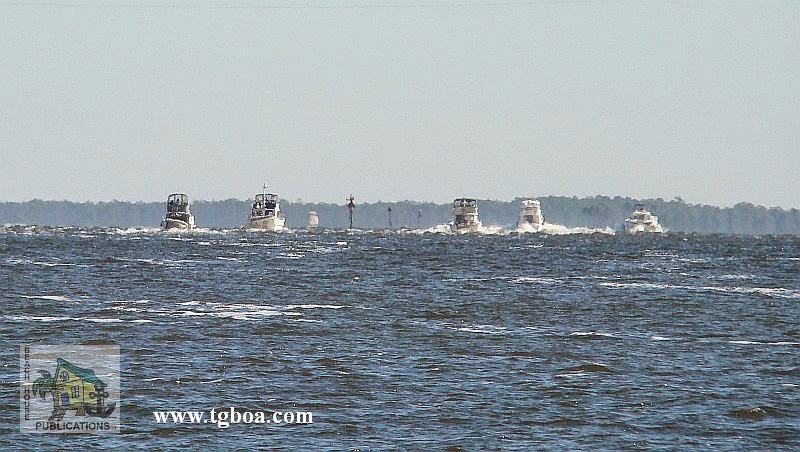
The ICW officially begins at mile marker zero in Norfolk, but for many, the journey begins much further north, usually somewhere in the Chesapeake or even as far as Maine. The trip to mile marker zero can be as exciting or as daunting as the waterway itself. Offshore or near offshore conditions are not uncommon and the boat and crew need to be prepared. Two things we noticed almost immediately on our run down the Chesapeake were that the traffic was going to be horrendous and the anchorages were going to be very crowded. The first day out we counted over twenty five boats within our immediate vicinity, all going the same direction. We remembered that first trip when we had long stretches of water alone and we were the only boat in many of the anchorages.

One sure sign of the changes in our society is the constant and vigilant presence of our military and law enforcement. From the Annapolis area to Norfolk, Virginia, we were within sight of a naval vessel at all times. After we entered the Norfolk area near the Naval yards the patrols and security were everywhere. Any vessel that strayed to the shipyard side of the channel was immediately intercepted by a security boat. Their approach was no nonsense. Their command was for you to move to the other side of the channel immediately or be arrested. We were buzzed at mast head level by fighter jets on the Pamlico Sound. The Marines at Camp LaJeune were practicing exercises day and night. We did anchor in Mile Hammock Bay in Camp Lajeune with no problem. As a matter of fact we and the twenty five other boats anchored there felt very safe and secure. The main ship channel in Miami was closed to boat traffic whenever a cruise ship was in port and the Coast Guard escorted most large vessels in and out of ports. Coast Guard and local law enforcement are constantly posted in all major ports we passed through.

It seems to have become acceptable for some newbie’s to hook up with what we dubbed the waterway Gurus. A fine old salt that had probably made the trip several times, or at least once, and taken some poor inexperienced crews under their wing. The Gurus planned out the trips each day, decided how far and at what speed their little groups should travel and where the anchorage for the evening would be. After communicating this information each morning, the group would then head out with the Guru at the lead, making all contact with bridge tenders for the group and making sure everyone was staying together. This made for interesting entertainment when two or more groups converged at a narrow part of the waterway and particularly at bridges. And it was a little confusing as to which Guru was directing which group. When we accidentally mixed in on occasion it was always made clear that “they are not with us”. It was also the Gurus responsibility to troubleshoot problems aboard any of their charges vessels as they presented themselves.

One of the sadder changes we noticed was the loss of comradery we had known over the years. With the forming of the “groups” it seemed that other boats and crews were considered outsiders and socializing outside the “group” was not a good idea. Fortunately there are still a few of the old time snow birds still making the trip that you still can meet up with old friends along the way. It may just be that with so many, many new cruisers, the mind set and attitudes of living ashore have not been shaken and the cruising mentality has just not yet taken hold. We can only hope.

Shoaling of the waterway has always been a problem, even on that first trip south. Some areas are still being dredged, but many others are not. Playing the tides and staying perfectly in the channel is sometimes the only way a deep draft vessel can use the waterway. Many times we “farmed the bottom” mid channel at mid tide. We often observed vessels running from channel marker to channel marker. We also observed some of those vessels running aground. A commercial tug Captain once told us to pretend we were a tug pushing an eighty foot barge when we transited the narrow channels. He suggested that dredging was done to accommodate the commercial traffic and not the pleasure boats. By imitating what a tug and barge would do, we would always find the deeper water. It worked just as he had told us. Meetings are currently being scheduled up and down the east coast to discuss the impact to local communities and the boating public in general. There is talk about closing parts of the waterway. We feel this would be devastating. Each year the problem in some areas is increasing. As funds are diverted to more security and other issues the dredging of the waterway becomes less and less a priority.

Another more serious change we have seen is a real lack of good common sense and seamanship. Perhaps this too is due to the increase in the number of first timers to this annual migration. Each day the VHF brought vessels chastising each other, and there is much use of unkind words and phrases that we could not publish in this article. The waterway was designed and built for all vessels small and large to use but there seems to be two opposing groups. There are those that can travel fairly fast (you know who you are) and those that can not travel very fast (you know who you are). These groups seem to have become diametrically opposed and unable to transit the same body of water without some colorful conversations. It appears more and more that one group has taken a delight in making the other group as uncomfortable as possible. The unfortunate consequences are that at some point someone will get seriously harmed. There are certain rules for preventing that situation but in many instances neither side seems interested in those rules. In the interest of informing those unfamiliar, the rules of overtaking state that if you can not safely pass another vessel, you do not pass. Common courtesy from the boats that can’t travel very fast (you know who you are) dictates that you slow as much as possible to allow boats that can go faster (you know who you are) to pass safely. Those boats that can travel faster (you know who you are) must slow to a safe speed and reduce their wake so as not to cause damage or injury on the other vessel. Here is the procedure we have used successfully over the years without any complaints. We always approach the slower vessel dead astern of them and slow down to match their speed. We then call the vessel ahead to let them know we are there, which side we will pass on and ask them to slow down so that we can pass. We then pass as close in to the slower vessel as can be done safely and then move directly in front as soon as it is safe to do so. Once we are in front of the vessel we have passed, we can increase speed and go on our way with little inconvenience or discomfort to the other crew. It is a very simple procedure, but one that many have not yet mastered. Why can’t we all just get along?

I can’t mention the VHF without noting how many of our trucker friends seem to have made the conversion to boating. The chatter on the radio daily is full of folks wanting to know what their friends “20” is and if so and so “has their ears on”. To our brethren from the highway we say welcome. We are sure you will bring your professionalism with you to the water. That’s a big 10/4 good buddy.

We have many favorite anchorages and towns along the waterway and noticed the biggest changes here. Ten years ago we could travel for very long stretches without seeing any signs of civilization. It even caused a little anxiety in that we worried that if we had a serious breakdown, help was not close by. Many small towns brought welcome packages to the new boats that arrived each day. After this last trip we fear the time is not too far off that the waterway will be totally developed from one end to the other. Even now there are very few miles of unspoiled areas. It seems that many of our favorite towns have discovered the potential income from visiting boaters. Large anchorage areas such as Annapolis, Charleston, Vero Beach, and Marathon, to name a few, have set mooring buoys and are now charging cruisers. The City of St. Augustine is currently considering installing a mooring field in the entire anchorage area. We do understand some of the reasoning behind this. It is another case of a few spoiling it for the many. A number of our favorite towns along the way are off our must stop list because there are so many derelict boats anchored that there is only room for a few cruisers and the unattended boats are a safety hazard in bad weather. These poorly maintained, sometimes abandoned vessels become a burden on the local government when they sink or become navigational hazards. With the increase in the number of boats making the trek each year, this makes finding decent anchoring spots in these towns almost impossible.

Not all the news is negative. There is still enough area out there that peace and solitude can still be found. You just need to study the charts and look for places other than those written up in the guides. Many cruisers rush North or South and miss the great places off the beaten path. Small towns on the Pamlico Sound and Neuse River that many bypass still remind us of what cruising these areas was like that decade ago. Towns like Great Bridge Virginia still have free dockage and most conveniences are nearby. Elizabeth City still welcomes cruisers with a free town dock. St. Mary’s, Georgia has discovered the economic benefit of the cruising community. They have completely rebuilt the waterfront area making it very attractive to the boater. Yet few have discovered it. We have found anchorages some days by just making a right or left turn at the end of the day and dropping the hook close in to shore, just off the waterway. We do as much offshore running as weather will permit. We have to chuckle as we sail along the coast and listen to the shouts on the VHF from those inside. The numbers of bridges that have been replaced by 65’ spans since that first trip are increasing. Although care should be taken if your vessel has a tall rig. It seems some engineers have lost their tape measures and bridge height is not as advertised. Timing your trip so that you are not traveling during the peak part of the season can much improve your experience as well as following the rules of the road and maintaining a sense of humor. Nothing makes the trip more enjoyable than having your boat properly prepared and the crew well educated for what they will encounter along the way. Read the articles, cruising guides, and study the charts well in advance. And even then remain flexible and open. Safety and good seamanship are important on the ICW, the ocean, or sailing in your local waters. Slow down and smell the fish fry’s. Make the entire ICW as much a part of your destination as where you plan to spend the winter months. Give your fellow travelers a wave along the way and dinghy over at the anchorage and say hi. We have made many friends for life just practicing these simple courtesies.

Tuesday, March 24, 2009

Marine Trader Review

Marine Trader 34 Double Cabin

At the time of the fuel crisis of the 1970s trawler yachts enjoyed a brief period of increased popularity when fast powerboats, with fuel-guzzling engines, fell out of favor among powerboat owners. But, as boaters became more and more used to paying higher prices for fuel and the relative cost of fuel dropped, fewer people seemed to find these slow, plodding vessels attractive and their popularity waned.

However, driven by aging sailors searching for less demanding vessels and retires in search of a slower paced boating lifestyle, the last several years have seen a resurgence in the popularity of this type of vessel to the point that market demand has outstripped the supply of some models.

This style vessel is what is commonly referred to as a trawler yacht due to its resemblance, in appearance, to a commercial fishing trawler. The Marine Trader 34 Double Cabin is 33’-6" in length overall with a 30’-3" waterline length a maximum beam of 11’-9" and draft of 3’-6". The hull has a V-shaped bottom with a sharp entry forward that flattens considerably at the stern. There is an integral keel that runs nearly the entire length of the vessel. The keel fairs into the bottom near the bow and drops more than two feet below the bottom near the stern affording protection for the propeller and rudder.

The 34 is imported by Marine Trading International of Toms River, NJ, is built by CHB Marine in Taiwan and was introduced in 1974. The model remains in production 27 years after her introduction and is unquestionably the most popular trawler-styled yacht of this size ever sold in the U.S.

Marine Trader 34 hulls are built of a solid composite which consists primarily of chopped-strand fiberglass mat and resin. Longitudinal support is provided by wood stringers and athwart ship support provided by plywood bulkheads both of which are attached with or encased in resin and chopped-strand mat. This is far from what might be considered "high tech" boat building. In fact, there is little, if any, use of stitched or woven fiberglass fabrics that are generally considered to be significantly stronger than the materials used. However, in spite of the lack of well-engineered fiberglass composites and a propensity for osmotic blistering, the hulls of these vessels have held up reasonably well over the years. One must keep in mind though that these boats travel less than 10 miles per hour, seldom venture offshore out of the sight of land and are stressed very little.

Since the introduction of the 1985 model, the 34’s have been constructed with a molded, single piece fiberglass deck and deckhouse with balsa and plywood used for reinforcing. Post 1985 models have had their share of window and hardware leaks, however they have been significantly less problematic than their predecessors. Models built prior to 1985 were built with teak planked decks fastened through fiberglass into a plywood sub-deck. Teak decks were an option after 1985. Models built prior to 1975 also were built with plywood cabin houses sheathed in fiberglass cloth. The quality of workmanship, the integrity of joiner work and bedding of joints was very poor on these earlier models and, nearly without exception, has resulted in significant damage to decks and cabins as a result of water migration.

Restricted to a length of just under 34’, the designers have done an excellent job laying out an efficient deck area while, at the same time, maximizing interior space and accommodations. This is undoubtedly a primary reasons for the continued popularity of this model.

The side decks are quite wide and allow an adult to pass from bow to stern safely and comfortably. There is a substantial bulwark surrounding the deck and an added handrail for a safe, secure feeling. The foredeck and aft deck are necessarily small although there is space on the aft deck for a couple of folding deck chairs. The flybridge is accessed by ladders from the aft deck and atop the aft cabin and encompasses the entire main saloon cabin top. The bridge area can accommodate six adults comfortably although I would suggest such a load, over a period of time, will seriously stress the structure of the cabin top and owners should attempt to limit the loads to 800 lbs or less. There is access to the cabin from the aft deck through a sailboat-like sliding hatch and companionway and along the starboard side to the main saloon through a fore and aft sliding door.

The 34 is rigged with a mast and boom for carrying a steadying sail although, in most cases, the mast is used only for mounting radar and radio antennas or raising flags.

The main drawback to the deck layout is that there is no convenient location for carrying a dinghy on deck without seriously limiting access.

Whether going away for a weekend or an extended cruise the Marine Trader 34 Double Cabin is a very livable boat which offers completely separate and private accommodations for two adult couples, plus plenty of room for stores and belongings. Headroom is well over 6’ throughout and interior furnishings are recognizably Taiwanese with teak everywhere except for cushions, deckhead liners and some counter tops. Even with all the dark finishes, there are plenty of windows and ports to keep the interior from appearing dark.

The forward cabin has port and starboard berths arranged in a "V" configuration that are large enough to be comfortable for an adult. The cabin also has a large hanging locker opposite a head with integral shower. The side on which the head and hanging locker are arranged may differ with the year of the boat.

The main saloon area is mid-ship and features a galley forward along the port side with a small settee aft. To starboard, there is an L-shaped dinette aft and a lower helm forward. Access to the engine room is through the main saloon cabin sole.

In the aft cabin there is a double berth along the starboard side along with a second head with integral shower. Along the port side there is a single berth (usually used for extra storage) and a large hanging locker.

The standard engine offered on the Marine Trader 34, since its introduction, has been a single, six cylinder, Ford Lehman marine diesel. Early on this engine was rated at 120 hp and later models increase in rated horsepower to 135. Over the years there have been several larger engines as well as twin engine options offered although I think its safe to say the majority of 34s were fit with the very dependable, standard Ford Lehman engine.

Powered with the standard engine the 34 is not a fast boat however, she is extremely efficient when operating at displacement hull speed. At 8.5-mph she sips a mere 2.2 gallons of fuel per hour and will cover a range of more than 900 miles between fuel stops on her 300-gallon fuel supply. This efficiency disappears rapidly however when pushed to the limit and, at a maximum speed of about 10-mph, [a 19% increase] fuel consumption jumps to a whopping 7.3-gph [a 230% increase] and range is more than cut in half. Similar small increases in speed at the cost of fuel consumption can be expected with larger engine options. For example, the optional 210-hp Cummins diesel will increase the maximum speed to around 14-mph, consume more than 12-gph and reduce effective range to under 300 miles.

Steering controls are either mechanical or hydraulic depending on the year of manufacture and both tend to be a little sluggish. Generally speaking, handling is what is expected for size and style of boat and acceptable once one gets used to the less responsive feel of the helm.

It is not uncommon for older model Marine trader 34s to need significant repairs. The most expensive and common problems are badly deteriorated teak overlaid decks and rusted leaking fuel tanks. Deck repairs can range from $5,000 to more than $20,000 depending on the seriousness of the problem. Although I have seen a number of steel fuel tanks successfully patched, repaired tanks are more prone to spring a leak somewhere else and the best course of action is replacement. The engine must be moved or removed to replace the tanks so, on top of the cost of about $1,500 each for fuel tanks, the installation is likely to cost another $2,500 to $3,000.

Even newer model vessels may have problems in need of attention. For example, the builder does not strictly adhere to the voluntary standards of the American Boat and Yacht Council that have become the bible for most American boat builders. This may only be the nuisance of having every positive DC electrical wire aboard colored red and no wiring diagram to sort them out, or could be as serious as not having the AC electrical system properly grounded. Cost to upgrade these systems to ABYC standards can cost from several hundred to thousands of dollars.

More Marine Trader 34s have been built than any other vessel of this size and type and, for this reason, there is seldom any difficulty locating used boats offered for sale. Due to variations in age and extreme variation in condition, most anyone interested can find a boat to fit their budget. In researching this article I quickly found 14 boats offered for sale. They ranged from a 1974 model in Connecticut offered at $12,000 to a 1991 model on Lake Ontario offered at $96,000. If you’re inclined to new rather than used, a new boat can be ordered from Marine Trading International with a base price of about $140,000.

For support there is the Marine Trader Owners Association (MTOA) which is one of the most active owners associations there is. The association offers social functions, cruises, rendezvous, a newsletter and great support for other Marine Trader owners.

The Marine trader 34 Double Cabin is a very comfortable coastal cruiser that generally offers excellent value and an outstanding owners association/support group. As you will find if you search, there are some dirt cheap 34s on the market which only offer excellent value if you are a very handy person with enough patience, time and money to restore one of these problem-laden models. If not, look for a model that may be less of a bargain price but in considerably better condition. Be aware that a competent and diligent marine surveyor is likely going to make suggestions for maintenance or upgrading of electrical and fuel systems. It is quite possible your insurance company will insist on these recommended upgrades prior to insuring the vessel so it is wise to get estimates for any recommended work and plan for the cost of these upgrades when considering the purchase.


Jack Hornor, NA is the principal surveyor and senior designer for the Annapolis-based Marine Survey & Design Co.

Principal Dimensions & Specifications
Measurements should be considered approximate and the manufacturer’s specifications may be relied upon. Bow & stern appendages are generally excluded.

Length Overall

33’ 6"

Maximum Beam

11’ 9"

Maximum Draft

3’ 6"

Displacement/Weight

17,000

Fuel Capacity

300 Gallons

Water Capacity

150 Gallons

Top Speed Range

10-14 Mph

Sunday, March 22, 2009

Our Anchoring Platform Refurbishing

Storm season is only a few months away so consideration needs to be given for what projects take priority. One important one not yet completed is the anchoring system, so that has become number one on our list. Early on. the windlass was mounted on the anchor platform but that was as far as it went and no electrical has been connected nor the new anchor rode and anchor installed. As with other projects, this one needs to start from scratch and get the entire system done right the first time so we won't have to redo it or make any repairs any time in the near future. The platform that holds the windlass and the anchor roller is teak and in the same condition as the rest of the teak on the boat. Under that platform is another that is grated and gives us working space and a stowage area for lines and fenders and whatever. It all needs some serious reconditioning and we gave a lot of thought as to how and what we wanted to use to refinish the whole area. It is really not practical to redo the area with Cetol since it will get a lot of use and abuse raising and lowering the anchor not to mention cleaning the rode constantly with the wash down system. Once again we used what worked on our previous boat and decided that the area would benefit from a good painting. Our paint of choice is AwlGrip.

Careful attention also needs to be paid to the surrounding areas, so taping and covering with a good painters paper to protect it is important. After all of the hardware and the windlass was removed, all of the wood was thoroughly sanded with a 120 grit sand paper to get the old deck stain that had been used on it off and the surfaced smooth enough for the primer and paint. This did require removal of a lot of wood but was necessary to get the finish we wanted. In addition I felt the platform itself that would hold the windlass and anchor roller needed some reinforcing to beef it up and give everything a better support for the stresses that might be put on it under severe anchoring situations. A piece of teak plywood about 3/4 inch thick was cut to the same shape as the platform, except about 1/2 inch smaller all around. All of the wood surfaces were saturated with CPES (a penetrating epoxy sealer), including the new reinforcement piece, and allowed to dry for 48 hours. Next the reinforcement plywood was covered with a thickened West System Epoxy and screwed to the underside of the windlass platform. By gluing and screwing the two pieces together the strength was improved considerably. Once the epoxy had time to set, everything was sanded with 220 grit sand paper in preparation for the first coats of primer.

AwlGrip 545 primer is a two part primer with a thinner that can be applied by brush, roller, or spray, and can be used above or below the water line. Spraying is not an option so we would be applying this using a roller and foam brushes. The 545 is mixed equal parts, or 1 to 1, of the primer and its converter. A brushing thinner is added at about 1/4 part, to help with the flow when applied this way and increase the open time more than if spraying. After all three parts are combined the mixture needs to be stirred thoroughly and allowed to set for about 20 minutes to "cook" in the container before applying. The primer can be applied by brush or roller and if done by roller, an epoxy roller works best. Many folks roll the primer on and tip it with a brush or foam brush. I have developed a technique that allows the primer, and the paint too, to be rolled on without tipping. It requires that I continue to roll until the bubbles are gone and the primer begins to show a slight alligator texture. At that point I stop rolling and move on. It takes a bit of practice to find the point at which you quit rolling and move on without stopping too soon and wind up with bubbles or continue too long and cause the roller to lift too much primer off the surface. Any areas that the roller can't cover is reached with a foam brush, which I prefer over a brush. I usually carry a few foam brushes in my pocket since the epoxy in the primer and paint breaks down the foam after a while. So i just toss them when they reach that point and start with a fresh one. The surface gets three coats of primer allowing 24 hours between coats and sanding with 220 grit. The surface is blown off with air, wiped down with a tack cloth and a thorough wipe down with AwlPrep before each new coat. Once the final coat has had time to dry, attention is given to a more finished sanding to insure a good smooth finish to apply the topcoat paint.

For the final finish we decided on AwlGrip Sable Tan to keep from showing so much of the dirt and mud that would come up with the anchor rode. In addition the dark color would accent the adjoining teak and tan decks as well as speed the drying process in the sun. This will also require 3 coats with 24 hours and a good sanding with 220 grit between coats. The topcoat is mixed 2 parts topcoat to 1 part Cat3 converter and 0 to 1/4 part brushing thinner. This mixture also needs to sit and "cook" for about 20 minutes before applying. To put on the topcoat I also use a roller, but for this a different type is needed. The only roller I have been successful with is the white foam rollers that look kind of like a small hot dog. It is about 4 inches long and slides on a roller handle that is no more than a thin shaft. The technique to get a smooth finish is to keep the paint on the roller light, don't load up too much, and roll out as much as you can while continuously moving the roller until the bubbles stop and you get that alligator texture to the paint. You have to continue to move on the space since if you overlap as the AwlGrip begins to set, you will see the overlaps. Don't worry about the alligatoring since the AwlGrip will actually tighten up as it dries and the texture will go away. After each coat, the sanding process should make the surface smoother and smoother. The AwlGrip instructions call for a 300 grit sandpaper but I have had better luck with adhesion using the 220 grit. The finished product looks great and we have been told by professionals that it is almost impossible to tell it was not sprayed. After the last coat has had sufficient time to thoroughly dry, all of the bits and pieces should be bedded as needed and carefully reinstalled. The final installation will be the windlass, but that is for another posting.

Tuesday, March 10, 2009

Some Time On The Water

The temperatures here in South Carolina reached near 80 degrees this past weekend, only a few days after we had seen highs in the 40s and lows in the 20s, so it was just too nice of a day to sit in the slip and work on projects. Every once in a while we have to stop and tell ourselves to enjoy the boat and not work on it all of the time. As we have refitted each boat for cruising. we have worked hard and long getting equipment installed and repairs made so when the time came to head out on a cruise, we untied the docklines and were still doing projects. This time we will spend some time on sea trials and using the boat and new equipment we install before we start our next cruise.

The current here in the creek runs strong through the marina so entering and leaving the slip has to be timed for slack water as much as possible. It is tight getting in and out and since our experience with the boat is almost nil, we will tend to be more cautious until our skills and confidence levels are higher. We had a low slack water at around noon, so started our preparations for leaving the dock about 11:30 AM and backed out of the slip a little before noon. For some reason, it seems to take less effort and preparation to get this boat ready to shove off than it did the sailboat.

We had a moderate southwest breeze and absolutely crystal clear blue skies. A perfect spring day for a short trip on the Beaufort River and the local boating community was taking advantage of the great weather. We headed north toward Brickyard Creek, keeping an eye on the depth sounder since it was a low, low tide. We chose not to run Brickyard Creek because we knew there were some very shallow spots and did not feel like finding the bottom today. Along the way we found a local Police boat that for some reason was sitting high and dry way up in the marsh grass. No anchor out or any visible signs of the boat being secure and too far up in the grass to be re-floated at high tide. At least that is the way it appeared to us. Before we hit the shallow areas we turned around and headed for the downtown waterfront.

Beaufort has been one of our favorite stops along the ICW for many years. The main Marina is right in the heart of downtown and is a stopover for almost all cruisers along this stretch of the waterway. The town has that old southern charm and main street is lined with shops and restaurants. The old style hardware store that was a favorite of many has closed and is now art stores and variety shops. The streets out of town are lined with old southern mansions and trees with Spanish moss waving in the breeze. Unfortunately there are no grocery stores, hardware or parts supply stores in the downtown area, but you can find most else. As we cruised past the Downtown Marina, we found there were a few cruising boats tied up at the end of the T-dock and the usual group of suspects were at anchor just out of the channel. Many of these boats have been here for years but there is still plenty of room if one preferred to anchor instead of staying at the marina. A free dinghy dock is provided for the boats anchored out. If a tour is to your liking, the marina hosts horse drawn buggy tours of the town.


We got a big kick out of going back and forth under the Lady's Island Bridge without having to wait for an opening. With a 20 foot air draft, it will be great to not have to deal with many of the bridge opening schedules and some not so friendly bridge tenders. The boat was handling well and getting a much needed exercise of the engine. If there is one thing a diesel engine does not like, it is to sit around and not be used. We also needed the practice in this new to us boat before we head out into the sunset. The time flew by and we headed back to the slip before the currents from the incoming tide reached maximum. We got back into the slip without incident and our neighbors hardly knew we were back. All in all, one of those great days on the water.

Sunday, March 1, 2009

Showers Coming Soon

No not rain showers. Although the boat is now 28 years old, apparently none of the previous owners ever showered aboard. There were no drains or plumbing to allow anyone to shower in either head and since we seldom use marinas when we are cruising, and quite often spend our time in remote areas, the ability to take a daily shower is important to us, and important to morale. We knew from the beginning that we would need to install a shower but since we are tied to the dock with showers close by, other more important items on the to-do list took precedent. But the project finally came to the top of the list and the time is now. One of the things we always stated as a requirement for a boat was a separate shower stall. Our last sailboat did not have one and the new trawler does not either. But this time we did have a good alternative. Beach House has two heads, one in the main stateroom and the other in the forward cabin. We seldom have guests aboard for long periods so having two heads is not important to us. The forward head is also small, having the head, a pull out sink and the beginnings of a shower pan. From the beginning, we planned to convert this smaller head into a dedicated shower.

It is important that the shower not leak. either into the bilge or into the woodwork in the surrounding cabin. The first order of business would be to re-fiberglass the shower pan using cloth and West System Epoxy. I chose West System because of past good results and the fact that epoxy will adhere to whatever was used on the floor to begin with. A thorough sanding, a coat of epoxy, then two layers of cloth gave the floor a little additional strength and waterproofed it well. Special attention went to the edges to be sure they were well saturated and the pan was sealed. Additional coats of epoxy went on before the preceding coats set up with a final coat which was thickened slightly and tinted using epoxy tint. This eliminated the need to paint, which usually does not last long in a shower, and also "fared" in the rough spots . The results were a solid, smooth, waterproof surface that would be easy to clean. Getting the pan to direct the water toward the drain is also important so you don't have water collecting in the corners. As the pan was finished, we installed a new drain that would be connected to the sump. Most of the drains we found at the marine supply were just too small and usually raised enough around the edges to create a problem. We found that an standard sink drain was larger, giving us a faster drain, and could be installed in a beveled hole to give us an almost completely flush installation. We also found a fitting that would screw on to it that had a hose barb the correct size we needed to connect an 1 1/8 inch hose to the sump. This would give us a complete drain without backing up while we were showering.

Which brought up the next issue, where to drain the shower water. Allowing it to drain into the bilge was never an option. It causes the bilge to smell worse that it normally does and allows all kinds of bacteria to grow down there, not to mention hair and stuff that will clog up the bilge pump. Since the shower pan is below the waterline. a direct discharge was also not an option. That pretty much leaves a separate shower sump. We could either build one or purchase one of the already made up units. We chose the latter and started researching which to buy. I am not a big fan of either Rule or Atwood products. Over the years I have seen too many failures in a very short period of time by either. But they are the dominating manufacturers in shower sumps so I began to consider building my own. One day at West Marine we looked at the West brand sumps and I inquired as to who makes the pumps. They are manufactured by Johnson Pumps which has a fairly good reputation, so we purchased one. I wanted it as close as possible to the shower drain and there is plenty of space in the forward bilge just below the shower. But this is not a flat area so a shelf needed to be fabricated to mount the sump. Using a piece of 1 by 12 oak and wrapping it in fiberglass, and of course epoxy, cutting it to fit and epoxying it to the hull in the bilge worked out to be perfect. The sump was attached to the shelf and the hose run from the drain to the sump. These boxes have several size hose barbs on them and it is just a matter of cutting off the sealed end of the barb you need.

Once the sump was secure and the drain attached, discharging the water from the sump overboard was the next step. This particular sump has a 3/4 inch attachment on the pump that sticks out the forward end of the sump box. Running the discharge hose from the box to a new thru-hull fitting was a simple task. We chose to put the thru-hull next to the discharge thru-hulls for the two bilge pumps on the starboard side of the boat.The thru-hull was installed in the boot stripe, just above the waterline so that it would not be running down the hull when it pumped the water overboard. A 3/4 inch bilge pump hose was run from the sump to the new thru-hull with a section looped higher than the water line even when heeled, to prevent backflow into the sump. This particular unit has a built in check valve at the pump to keep water from flowing back in, but this is just a good added safety measure. In a sailboat a vented loop would be needed to prevent backflow when the boat is heeled over. We always install our thru-hulls using 5200 for bedding and a marine grade plywood backing plate on the inside. In all of our years of boating we have never had a thru-hull we have installed fail or leak. At this point the project was moving along nicely.

Even though the pan was thoroughly sealed with epoxy, there are other areas that can leak into the adjacent woodwork. The inside of the head is covered in a Formica like material but the corners needed a bit more work. All corners, around the trim on the door and a few other places were thoroughly caulked. Taping off the edges to be caulked and using a curved plastic spatula to finish the corners, etc. make a clean professional finish. Just prior to caulking, all of the wood in the head that would be exposed to water received four coats of a gloss floor finish. This is much tougher than varnish, seals and waterproofs the wood better and stand up longer to constant exposure to soap and water.

All that is left is to connect the sump pump to the 12 volt DC system. It is a matter of running the proper size wire from the wiring that comes on the pump to the boats electrical panel. Using the proper size is important based on the voltage and amps the pump requires and the total distance the wire must run to the panel and then back to the pump. In calculating wire size, the round trip run must be used. Fortunately we have several spare breakers on the panel to use, and again sizing the breaker to the pump is important. To small a breaker will constantly trip and too large will not trip when you need it to and could be a fire hazard, especially on a pump. Once all of the wiring is run it needs to be secured well along its route to prevent chafing from constant movement. After all of the hoses are connected and the wiring run, the sump can be tested. Try to keep the discharge as close to the sump as possible as these pumps are usually small and don't push water for long distances well.

The final touches are connecting and running the shower head. We like the small hand held unit made by Scandivik as they can be used by holding down a lever when you need to rinse and then shutting off completely when you let go. This saves a lot of water and that is important to us when we are away at anchor for weeks at a time with no source for water close by. The shower hose is attached to a diverter on the faucet of the pullout sink. Since this sink will be used very little it will not be a problem. We have set up the shower curtains so they completely cover three sides so only one wall in the head will actually get wet. We will see how this works out since there are ways to be able to cover all four sides. There is always room for adjusting.

Oh, and did I mention we are working on the teak? We are finally at a point where there is less left undone then what we have finished. We love the Cetol, especially with so much wood to do, it makes the work go much faster. The forward windows at the lower helm were one of the larger sections to do and turned out quite well. Once the wood was refinished, the bronze hardware was cleaned up and reinstalled and looks great. New weather stripping was installed around the opening center window to keep the rain out. We found replacement wiper blades that fit perfectly and new cloth covers will be made soon. The window frames on the starboard side are done and really make the boat look good. All that is left on the lower deck is the window frames on the port side and the brows. Then we get to start the flybridge. So that is about it for now and we look forward to starting the work on the upper deck. Once the exterior is done the mechanical work can begin. The list is long.

Thursday, February 12, 2009

Florida Anchoring Rights Update

For many of us that cruise the east coast of the United States the antics going on in the State of Florida over the years regarding anchoring restrictions has been a source of concern and amusement. The latest most up to date information on the current situation can be found on Claiborne Young's site, Cruisersnet. So go by and have a look at where the regulations stand today

http://www.cruisersnet.net/western_florida/anchoring_rights/