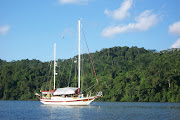
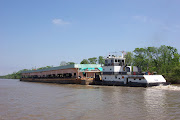
We were off the dock this morning at 7:30, a bit later than we had planned, and turned onto the Beaufort River heading north. This would be our first trip with the boat and all of the new equipment we have installed. The first few days, especially on an untested boat, always make us a bit anxious. The weather was absolutely perfect with temps in the low 80's and a moderate breeze. We cleared the Beaufort River and turned into the Coosaw. This can be a bumpy ride in the wrong weather but today it was wonderful. The Ashepoo/Coosaw Cutoff has been dredged so this once problem area has plenty of water. We found 9 to 14 feet in the lower cutoff and 16 feet or more in the upper section and we transited this right at low tide. The currents were with us and against us off and on all day. When it was with us we would make 8 knots or better and when against us, it slowed us down to 5 knots. Even the dreaded White Point area presented no problems when we followed the magenta line.
Beaufort, SC to Charleston, SC
We were off the dock this morning at 7:30, a bit later than we had planned, and turned onto the Beaufort River heading north. This would be our first trip with the boat and all of the new equipment we have installed. The first few days, especially on an untested boat, always make us a bit anxious. The weather was absolutely perfect with temps in the low 80's and a moderate breeze. We cleared the Beaufort River and turned into the Coosaw. This can be a bumpy ride in the wrong weather but today it was wonderful. The Ashepoo/Coosaw Cutoff has been dredged so this once problem area has plenty of water. We found 9 to 14 feet in the lower cutoff and 16 feet or more in the upper section and we transited this right at low tide. The currents were with us and against us off and on all day. When it was with us we would make 8 knots or better and when against us, it slowed us down to 5 knots. Even the dreaded White Point area presented no problems when we followed the magenta line.

Steering Issues And Preparing For A Cruise
 All of our recent activity has been for a purpose. We are preparing Beach House for a trip from our current location in Beaufort, South Carolina, to the Chesapeake Bay. We know it is the wrong direction for this time of year, but recent events have required us to head north. If all goes as planned we will leave the dock on Monday, September 14th and head along the ICW for the next 600 miles or so. We have made as many improvements as we felt were necessary to make the trip safe and comfortable.
One issue that took some extra work was the steering system. The upper and lower hydraulic helm pumps are Wagner 700 Series, very substantial and dependable units. The upper helm had developed a leak so we decided to send both units in for testing and service which included replacing the internal seals. We chose Florida Rigging and Hydraulics for the service since we had received good reviews from folks that had used them in the past. They did an excellent job and turned the units around very quickly at a reasonable price. They also spent the time on the phone to be sure we understood the requirements for bleeding the system and the proper fluid to use.
Replacing The Fresh Water Circulating Pump On Our Ford Lehman 120
 If you had read our previous post, we discovered the fresh water circulating pump on the front of the engine had developed a leak and needed replacement. The great folks at American Diesel were quick to get the replacement shipped to us and in my discussion with Bob Smith, he suggested that we replace the engine belt at the same time and be sure and replace it with the proper belt to assure there would be less likelihood of another issue with the pump soon. We agreed and had a belt shipped with the pump. The replacement was actually quite easy.
Servicing The Cooling System On Our Ford Lehman Diesel And Other Things
 After the transmission cooler was replaced we decided to also replace the oil cooler since it was probably the same age and condition. But after removing it we found it to be moments away from a total meltdown so the decision was a good one. We ordered the parts again from American Diesel and they arrived within a couple of days. When we went to re-install it we found the oil hose sizes on the engine to be different than the hoses need for the new cooler. So we ordered the correct size from America Diesel and they too arrived in a couple of days. Although not related to the cooling system, we had planned to add an oil changer to make the oil changing process much faster and cleaner. With the hoses off for the cooler we took the opportunity to drain the oil from the crankcase, using a small pump attached to a drill. This is slow and messy but the attachment for the oil changer needs to go in the bottom of the oil pan so it had to be drained.
More Marine Trader Makeovers
 We have been working fast and furious to get new projects finished for a possible trip north to the Chesapeake. One of the projects was to get the chartplotter installed at the flybridge, which we have had for months, and to reinstall the compass as well as replace the non-functioning amp gauge with a voltage meter. There are those that prefer an amp meter but we much prefer to know at a glance what the alternator is doing by the voltage it is putting out. The replacement was pretty straight forward with only a bit of rewiring. The compass had been mounted over on the centerline of the bridge so viewing it from the helm was a bit awkward. In addition I had built a box to mount the plotter
  rather than spend $300.00 for a navpod. The box was built from teak plywood, epoxied over and painted with Awlgrip. Since all of this needed to be mounted we decided to paint the helm area with Awlgrip before mounting the equipment rather than mounting it and removing it again later for painting. Both the compass and the plotter will be very helpful and important on the trip north. We choose the Standard Horizon CP300 plotter because we had used it extensively on our previous boat and were very pleased with the performance. We are not big fans of integrated systems so the stand alone plotter fit very nicely
  into our budget. IMO is the best bang for the buck, was very dependable for us in the past and is very user friendly with a simple menu set up. In addition it uses the C-Map navigation chip and again we do prefer that to other formats.
Transforming The Non Skid Decks
 This is an article we wrote for the July/August 2009 issue of Good Old Boat.
Anyone that owns or is considering the purchase of an older boat that is in need of some renovations has wrestled with what to do with worn or faded non-skid surfaces on the decks. There are several options including artificial materials glued to the decks, paints and coatings. Our Mariner 40 ketch, Sea Trek, has just had the 30th anniversary of the laying of her keel. We have lived aboard and cruised her extensively since we purchased her 16 years ago and the
 repairs and renovations have been ongoing from the beginning. While she had not been abused, she had not been used and was allowed to simply sit at the dock uncared for. Simple cosmetics like redoing the extensive teak trim was easy although time consuming. Our plans were two fold; first to bring her back to like new condition and second to make her as safe and comfortable as possible for offshore and coastal cruising.
Anchor Washdown System
 When we found our first serious cruising boat, Sea Trek, we did a shakedown cruise on the Chesapeake Bay on our first weekend of ownership. Upon our return to the dock that Sunday we put one project at the top of our to-do list. On our new boat, Beach House, we recently did a day trip with our visiting children and grandchildren. After a day of fishing and anchoring on the Beaufort River off Parris Island, and catching a few Shark and Redfish, that same project came to the top of our list once again. Nothing says you need a wash down system like hauling up an anchor and rode full of black goop that attaches itself to the anchor, rode, anchor platform, windlass, foredeck, anchor locker and anything else within a couple of feet of it. So once the kids were heading back north we began the project in earnest. Since all of the parts were already sitting on a shelf in the boat, starting it was easy. We always try to plan out each project and after careful study determine all of the main components ahead of time and gather them from whatever sources we know to be a dependable supplier. Many of the small items that make up the details are purchased as the project progresses.
A Hatch From Scratch
 Our article from the May/June 2009 issue of Good Old Boat
Sometimes a simple solution to a problem is not always simple. Although our former boat, Sea Trek is a great cruising vessel, there are a few things we wanted to change. One draw back was the lack of good ventilation below. With six opening ports we thought it would not be a problem. But with ten-inch high bulwarks around the deck it left something wanting. The only deck hatch is forward over the vee-berth. This is great for sleeping but still not great for airflow thru out the main cabin. We added strategically placed solar vents and cabin fans but in the tropical areas we usually cruise it was still not enough.


A Little TLC For Our Ford Lehman Diesel
 With the daytime heat in the 90s every day we are ready to spend time working inside the boat and enjoy the air conditioning. A couple of projects that have been in the back of my mind are perfect for a break from teak and painting. Well, as much of a break as working in the engine room can be. An issue with the Ford Lehman has been the overflow for the fresh water coolant. It is simply an overflow and does not draw the coolant back into the tank when the engine cools down as most diesels do. This requires that it be manually poured back into the fresh water tank as it accumulates and is kind of a pain. The folks at American Diesel,
  http://www.americandieselcorp.com/ , are the experts on the Ford Lehman engine. If Bob Smith or Brian does not have an answer to any question about these engines, then there is no answer. They do have a replacement neck for the fresh water tank that will allow the coolant to overflow and then return back to the tank. I had ordered one of these and have had it on hand for a while now, so it was time to install it. The installation is pretty straight forward and the old retainer that hold the cap needs to be notched with a hack saw blade so it can be bent inward and removed. The new neck is coated with epoxy where it will go down into the tank and with a little coaxing with a hammer and a block of wood it slides into place. Once the epoxy sets it is ready to be reinstalled and attached to the overflow tank.
Repairs, Failures, And The Domino Affect
 I am thoroughly convinced that most, maybe not all, major breakdowns and failures on a boat start with just one small thing and then the dominoes fall until you have a major if not catastrophic situation. OK, our situation did not become catastrophic, but it became much more than it started out to be, and it became very expensive. It all started innocently enough one very hot, sticky day about three weeks ago when it was necessary to clean the air conditioner sea strainer. The waters here in Factory Creek are very silty and full of all manor of stuff. The strainers requires cleaning at least every two weeks. The AC system was shut down and the
  seacock closed to keep the water out for what should have only taken a few minutes. The strainer was removed and the bowl and screen sat on the dock for cleaning. When I turned on the water hose, somehow the nozzle came off and the stream of water hit the strainer basket and blew it overboard into the water and it sank immediately. So this meant an hour and a half running around to the marine supply stores to find a replacement screen. Once a replacement was found the strainer was reassembled and the seacock opened. No water would come through the seacock to the strainer.
The Jungle Medic
 The following is a reprint from our article in Sounding Magazine. Enjoy.
Cruising does not always mean boisterous passages or cocktails on the aft deck at sunset. To the contrary, much of our time is spent exploring the country side and getting to know the local people. This approach for my wife Susan and I has enriched the experience far beyond what we expected when we moved aboard Sea Trek, our Mariner 40, and started the cruising life almost 18 years ago. Beginning in mid April of 2005 the passage from the
We had heard from many sources, of the wonderful work done here by Bryan Buchanan and his wife Riechelle. Bryan Guatemala
A Trawler Makeover
 With all of the reality TV shows bordering on the ridiculous this might not be a bad idea. We certainly are delighted with the progress on Beach House and the compliments pour in from everyone that sees her. Especially those that have seen her prior to our taking ownership. The transformation has been amazing and when we walk down the dock we sometimes have to stop and admire our handy work. We are still a long way from being cruising ready since most of our efforts have been on the exterior and redoing and improving the teak, paint and canvas. Electrical and electronics have been slow going and we have only completed what needs to be done to keep her safe and keep the on board equipment working. With the heat of the summer bearing down on us hard, it might be time to work on interior projects in the air conditioning.
Refinishing The Hatches
 We have not slowed down on the projects we just haven't posted because we have been so busy. The teak on the exterior is just about finished, leaving the flybridge yet to be done. For the last couple of weeks we have been repairing and refinishing the forward hatch and the hatch and entrance to the aft cabin. Both of these have leaked quite a bit requiring us to keep a sheet of plastic over the hatch under the canvas covers. Once we had them off it was quite apparent why. The forward hatch had two pieces of glass in it that was set in a grove with the edges exposed and held in with caulk. The caulk was old and in spots broke down and the water was able to get in around the edges. Once the wood was thoroughly sanded and the old caulk removed, we recaulked with
  3M 4200 and put a nice teak trim over the edge of the glass and overlapped the wood. With the caulking underneath sealing everything it is now water tight. A good thunderstorm this afternoon affirmed that we had indeed solved that problem. A few seams that had opened up were also sealed with West System Epoxy. As with all of the exterior wood we had to sand off all of the deck stain the previous owner had applied. We did find a product at the local hardware store that was for removing deck stain and it did make the job much easier. Both the inside and outside of the hatch needed to be stripped and sanded.
Cruising In a Down Economy
 My wife Susan and I made the decision almost twenty years ago to buy a boat and go cruising while we were still young and healthy enough to enjoy the lifestyle. Watching friends plan and work for years, then have their dreams smashed on the rocks due to health or family issues was a driving factor in this decision. The one major stumbling block in our plan was the financial aspects. We are neither wealthy, retired with a pension, or on the list of a family member to inherit a lot of cash. So how in the world would we accomplish this with no income once the dock lines were untied and we left our home waters?
  Those are tough and scary decisions but they needed to be overcome if our plan would work. The solution would be to buy the boat with the sale of our property and business, outfit it for extended cruising, put enough money in the bank to carry us through our cruise, and then get us to a place where we could settle in and find jobs to build the cruising kitty so we could start again. For the plan to work, we also needed to keep our expenses to a minimum without making our cruising lifestyle a bit more than a survival existence. It was important to us that we enjoy the ride and have a great time or it did not make sense to do this at all. After 17 years aboard our Mariner 40 ketch, Sea Trek, and with tens of thousands of miles under the keel, we are now switching gears and have recently purchased a Marine Trader 34 trawler so that we might enjoy some new cruising grounds that are just not practical on a deep draft sailboat.
Installing An Electric Anchor Windlass
 Once again, it is hard for us to believe that after 28 years and an unknown numbers of owners this boat has never had an anchor windlass. We have to think that it did not get much anchoring done over its lifetime but someone somehow managed to bend the shank on the 35 pound CQR that came with the boat. Our cruising style is more anchoring and less marina stays so getting the anchoring system right is very important and with a new storm season less than a month away we felt is was past time to get it done and get it right. An anchor windlass is an important part us our system.
Once the anchoring and bow platforms were refurbished, see our post here,
 the next step was to find a windlass that would fit in the space behind the anchor roller and in front of the Sampson post. This is not a large area so a windlass small enough to fit but powerful enough to handle the anchor and rode did not leave us with a lot of choices. Additional weight at the bow is another concern for us. The one we finally decided on that would fit our needs is the Powerwinch. We usually take any manufacturers specs with a grain of salt and any time they are marginal based on their numbers, we go with the next larger size. We sized the windlass, rode, and anchor for a 40 boat. This meant the Class 41 windlass from the Powerwinch line. It fit our space, did not add a lot of additional weight on the bow and seemed to be more than powerful enough for Beach House. The one down side was it does not have the capabilities to manually raise the anchor if power or the windlass quits, but we can live with that since the large anchors and all chain rode we used on our sailboat are a thing of the past.
Sliding Door Repair For Exterior Door

 The repair of the side entrance door has finally come to the top of the to-do list. It has been something that has needed to be done since we bought the boat and every time we come and go it reminds us that we need to get it done. I can't take credit for the idea, it was suggested to me by another member of the Marine Trawler Owners Association. I had ask the members for a source to find the rollers on the bottom of the doors that had worn out some time ago. This made sliding the door difficult and it was noisy when it rattled around when opening and closing it, plus the latches to lock the door open and shut would not line up and was a pain to lock. Another MTOA member suggested that the track and rollers be replaced with UHMW plastic instead of trying to replace or rebuild the rollers. This type of plastic is very durable, easy to cut to shape and most importantly will slide very easily against itself with very little friction. We found the plastic here, and ordered it on line. The product was very inexpensive and arrived only a few days after we ordered it.
WiFi Adapter For The Boat Revisited
 Part 2.
 For over a year now we have been able to get some hard evidence on the performance of our WiFi adapter and it has surpassed our expectations. We have been able to receive connection from at least three miles away that we can confirm and it has worked in areas where we had no idea of where the signal was coming from and at what distance. So we do declare it to be a complete success. For the original info see our post here .
You activated your EPIRB... now what?
You activated your EPIRB... now what?
| Have you ever wondered exactly how one actually gets rescued after they pull the trigger on their
 406mhz Emergency Position Indicating Radio Beacons (EPIRB)? Or what about if you happen to be that unlucky soul who didn't register their EPIRB? Well I thought I would run down the quick and dirty of what happens when the Search and Rescue system is activated by the use of an EPIRB and a little hypotheticalness. Before I do this though I'll let you know that I am not an expert in the ways of being a SAR Controller, I am what's considered a junior as I have just under a year of real experience. That being said, I been down the road plenty of times to discuss how it works and I invite all of you Salty SAR Dawgs out there to fill in the gaps or leave your comments.
Fire Extinguisher Recall
We just came across this recall notice for some Kidde Fire Extinguishers. Please click on the link and check to be sure you do not have one on board
http://www.cpsc.gov/cpscpub/prerel/prhtml09/09151.html
http://www.cpsc.gov/cpscpub/prerel/prhtml09/09151.html
Subscribe to:
Posts (Atom)